"Yeh naukri hai ya business?" My cousin's father asked her this the day she mentioned Digital Marketing, right after she finished her B.Com with no clear plan for what came next. Not an unreasonable question. It captures how unfamiliar this profession still feels in a lot of Indian households, even though it quietly runs behind nearly everything we buy now.
You've booked a doctor's appointment because a Google ad showed up at the right second. Bought a kurta at 11 pm because an Instagram reel caught you mid-scroll. Received an email nudging you that your cart is "waiting." Somebody built each of those campaigns, watched the numbers, and adjusted what happened next.
That's the interesting part about Digital Marketing. Much of it happens quietly in the background, yet it increasingly shapes what we discover, what we click, and sometimes what we buy.
What Is Digital Marketing, Really?
Put simply, it means using online platforms, search engines, social media, email, websites, all of it, to reach people and push them toward some action. Buying something. Filling a form. Downloading an app. Or just remembering your brand exists next time they need something.
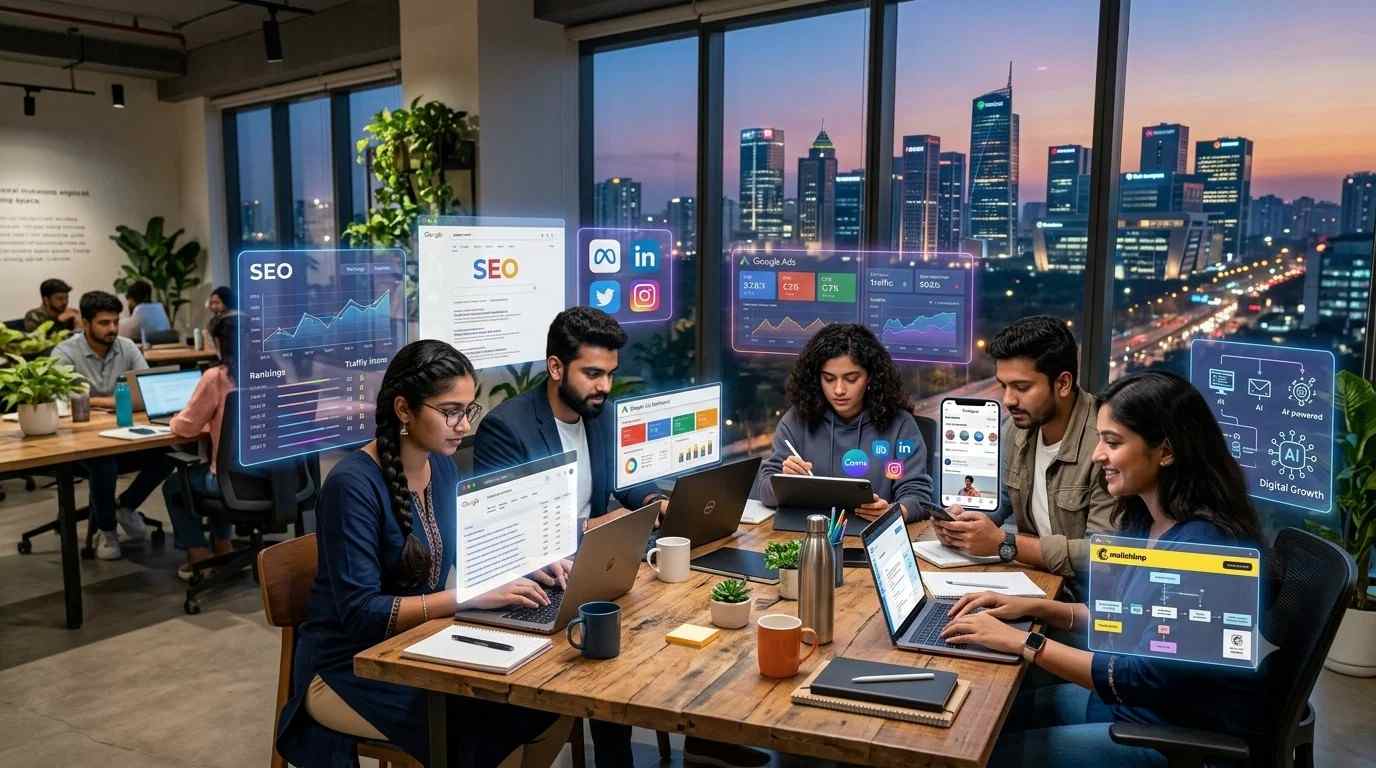
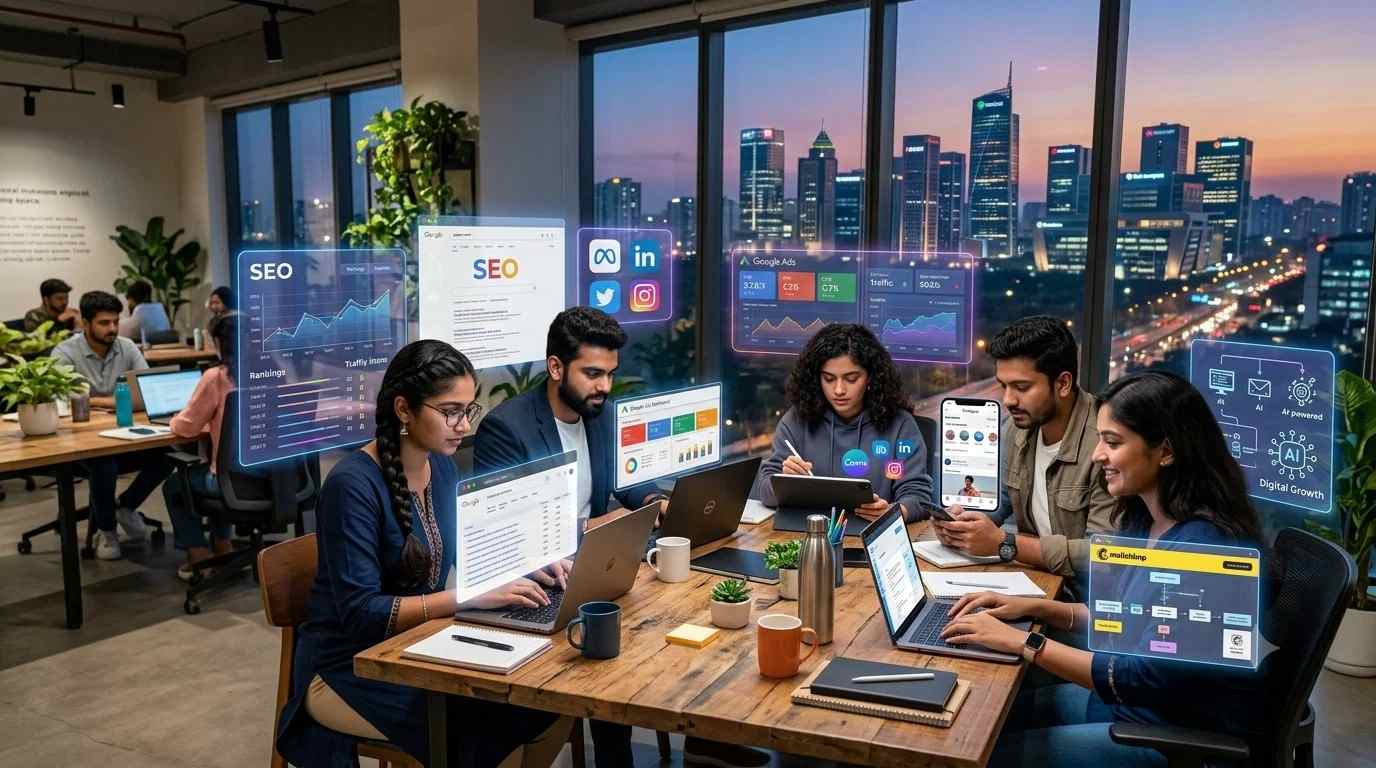
Most people assume it's one job. It isn't. Search Engine Optimisation (SEO), Social Media Marketing, Pay Per Click (PPC), Google Ads, Content Writing, Email Marketing, Affiliate Marketing, and a handful of overlapping specialisations sit under one umbrella. A person might search for something on Google, watch a related video on Youtube, see a product on Instagram, and later click an advertisement for it. Different channels, different moments, but often the same digital journey.
Why Is This Field Exploding in India Right Now?
Roughly 900 million Indians are online at this point, and that figure keeps pushing into smaller towns each year without any visible slowdown. Cheap mobile data changed part of the equation. UPI changed the rest. Getting people online was only step one; their wallets followed soon after.
Visit any tier 2 city and the evidence sits everywhere. A tuition centre in Meerut runs Facebook ads before admissions season opens. A saree shop in Varanasi now takes orders through a WhatsApp catalogue instead of relying purely on walk-ins. A gym in Nagpur pushes its annual membership deal through Instagram stories. None of these are large operations, yet each now leans on some form of Digital Marketing just to hold its ground against the shop next door.
Add the wave of homegrown D2C brands that built entire customer bases online rather than through television, and the result is an industry that can't find trained people fast enough. That shortage, more than anything else, explains why the scope of digital marketing keeps stretching wider each year.
It Has Moved Far Beyond Tech Startups and Metro Cities
Perhaps the biggest plus point here is that this work no longer belongs to any one type of business or any one part of the country. A few years ago, digital marketing meant tech startups in Bangalore and e-commerce brands in Mumbai. That's not true anymore. Real estate builders run lead generation for under-construction flats. Hospitals and diagnostic centres fill appointment slots through Google Ads. Wedding photographers in Jaipur and event planners in Lucknow time their Instagram pushes around peak wedding season. A small team in Coimbatore can handle SEO for a business for clients based in Dubai without ever meeting them in person.
The numbers back this up too. India's digital ad spend has grown at a steady double-digit pace year on year, according to recent estimates, with nothing suggesting a slowdown soon. Zomato, Nykaa, and Meesho built entire departments around this function. Thousands of smaller companies that never make headlines did the same. Plenty of early-stage startups hire their very first proper marketer as a digital marketing executive, sometimes before there's even a formal sales team in place.
Businesses aren't hiring based on your degree or your city anymore. They're hiring based on whether you can actually get results, and that's a rare kind of fairness in the Indian job market.
Where Do You Actually Start, Though?
That's the part most explanations skip past. They list the channels like items on a menu and leave you standing there wondering which one matters for your situation. Search Engine Optimisation pulls people in when they're already looking for something. Google Ads puts you in front of them before the organic results have had their say. Social media builds familiarity in places where people are killing time, not actively shopping. Email waits patiently for someone who already showed interest once. Each does a different job, and treating them as interchangeable is where a lot of wasted money starts.
The tricky part is that a local business surviving on neighbourhood foot traffic and a direct-to-consumer brand shipping nationwide are playing different games entirely. One might live or die on Google Ads during a seasonal rush. The other might spend six months building organic visibility because paying for every click would eat the margin alive. There is no universal answer, only a question of fit.
If you are trying to figure out which channel deserves your attention first, you need more than a list of names. You need a breakdown of SEO, PPC, social media, and email marketing in India that accounts for what each one actually costs, how fast it works, and where it fits for a business operating here specifically. The rules are not the same across towns and industries, even if the platforms are.
Let's Be Honest About the Challenges Too
This work isn't smooth all the time, and pretending otherwise would be dishonest.. Burnout shows up regularly, particularly inside agencies juggling multiple client deadlines at once. Platforms keep rewriting their own rules, so you're never fully "done" learning, and plenty of people find that draining rather than exciting. A fair reaction, not a weak one.
There's also noise in the training space worth acknowledging. Courses oversell quick success stories that don't reflect what most learners go through. Many beginners feel disheartened within their first few months because results don't arrive as fast as the advertisements promised. Normal, though. A credible portfolio takes real time, usually several unglamorous months of consistent work before anything clicks into place.
A Realistic Closing Thought
Nobody running a business today can afford to ignore this space, and nobody should walk in expecting instant results either. What holds true, regardless of the industry or the city, is that digital marketing rewards consistency over quick fixes. A campaign that looks slow in its first month often builds into something worth noticing by the third or fourth.
The tuition centre in Meerut and the hospital chain in a metro city are, in a strange way, playing by the same rules now, just at different scales. Understanding those rules, even as an outsider watching from the sidelines, tells you far more about how business actually works in India today than most people give it credit for.
Frequently Asked Questions (FAQs)
1. What is Digital Marketing?
It's basically reaching people through online channels — search engines, social media, email, your website, paid ads — instead of relying only on print or TV. Most brands now use some mix of these to get in front of the right audience.
2. Why is Digital Marketing growing in India?
Cheap mobile data, more people shopping online, and UPI-style digital payments have changed things a lot over the last few years. More people online simply means more reasons for businesses to be there too.
3. What are the main types of Digital Marketing?
SEO, social media marketing, Google Ads, content marketing, email marketing, and analytics cover most of it. Some businesses use all of these together; others pick two or three that suit them.
4. Is Digital Marketing only useful for large companies?
Not at all, a tuition centre or a neighbourhood clinic can benefit just as much as a big brand. In fact, for small businesses with limited budgets, it's often more practical than traditional advertising.
5. How does SEO help with Digital Marketing?
SEO is what gets your website to show up when someone searches for something related to what you offer. Rank well for the right terms, and people find you without you having to pay for every single click.
6. How do social media platforms fit into Digital Marketing?
Instagram, Facebook, YouTube; these are where a lot of people spend their time, so brands use them to share content, talk to their audience, and pull traffic back to their site. A gym posting workout clips or a restaurant sharing daily specials is a common example of this in action.
7. What role does Google Ads play in Digital Marketing?
This is paid search, you're paying to show up when someone types in a query related to your product or service. The advantage is you're reaching people who are already looking, not just scrolling past an ad.
8. Why is content important in Digital Marketing?
Good content answers the questions people actually have, and that builds a bit of trust before they even talk to you. It also feeds into SEO and social media, so it's rarely working alone.
9. Does Digital Marketing require constant learning?
Yes, and this is one part people underestimate. Algorithms change, ad platforms update their rules, and what worked last year might not work as well now, so staying current matters.
10. Is Digital Marketing limited to India's major cities?
No, and this has shifted quite a bit. With internet access reaching smaller towns, local businesses outside the metros are using digital marketing too, not just companies in Mumbai or Bangalore.
Comments