Imagine you built a website. Wrote the pages yourself. Picked keywords you were fairly sure people searched for. Then you waited.
A few weeks later you look up your own business. Nothing comes up. You try something broader, closer to what a real customer might actually type. Still nothing. Or maybe the site does show up, technically, buried on page three where nobody bothers scrolling.
So what happened?
There's rarely one clean answer. Sometimes the content simply isn't pulling its weight. Sometimes your site barely exists anywhere else online: no mentions, no links, nothing pointing back from the rest of the web. And sometimes, and this is the one that catches people off guard, Google can't read your pages properly even though the writing itself is perfectly fine.
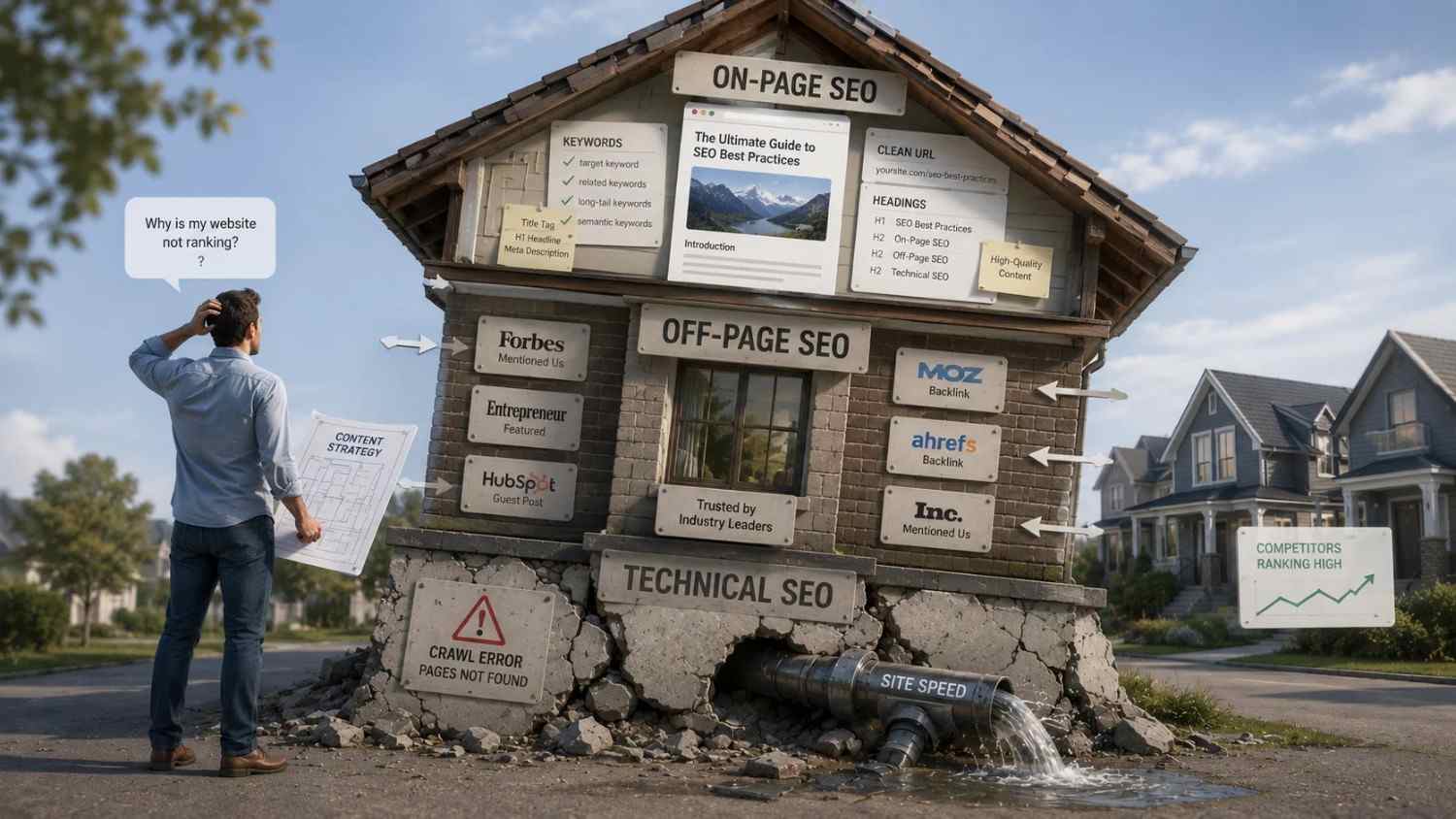
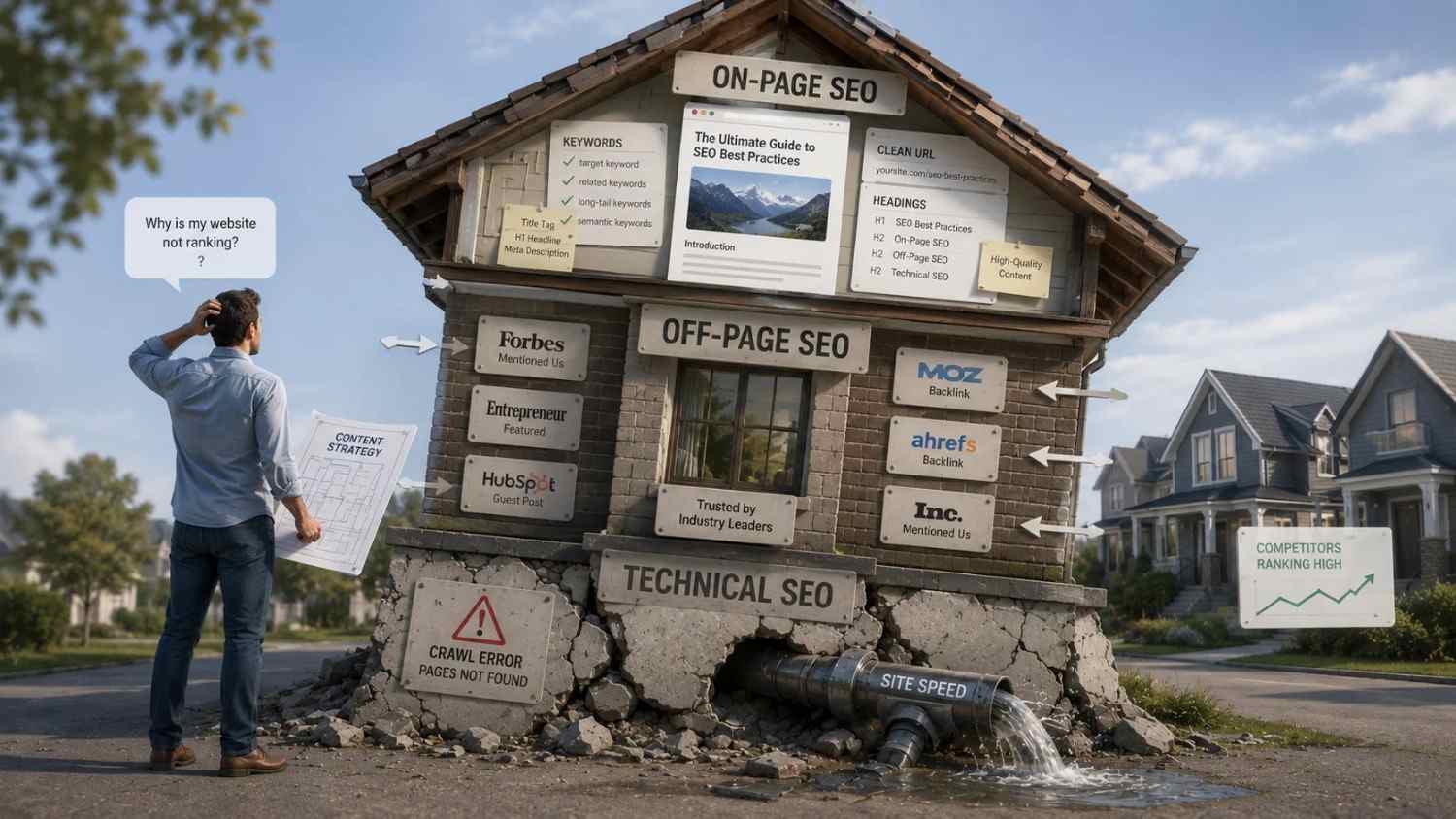
These three problems map onto three areas: on-page SEO, off-page SEO and technical SEO. You don't need to memorise the labels. What you do need to grasp is what each area actually controls, because fixing one won't automatically sort out the others.
Why Working On One Area Isn't Always Enough
On-page SEO covers the stuff you control with your own hands: the content, the headings, the words you choose, how one page connects to another. Off-page SEO lives out in the wider web, completely separate from your site. Are people talking about your business? Linking to it? Treating it as something worth sending their readers toward?
Technical SEO sits quietly underneath both of them. It's also the one people forget. Can Google even reach your pages in the first place? Can it read them properly once it gets there? You could publish the best page on the internet. It still won't rank if Google never manages to crawl it.
A website can struggle because of any one of these three. Often it's a mix of all of them.
On-Page SEO: Start With What You Can Actually Control
Might as well start here, since it's the part you can directly touch.
Take someone searching "best digital marketing course in Barasat." What are they actually trying to do? Compare a few institutes, probably. Check the fees. Read what past students said. Work out who seems trustworthy before they hand over their time and money.
That's the real starting point for on-page SEO. Not the keyword itself: what the person typing it actually wants. A page built purely because you have a keyword to target rarely satisfies anyone. Build it to answer what the searcher is really after, and the keyword usually slots in on its own.
Quick test: read one of your pages back. If the same phrase shows up in nearly every sentence, you didn't write that for a person. You wrote it for a search engine. And search engines are fairly good at spotting the difference these days.
When the content actually answers the question, the rest of on-page SEO is about making that answer easy to find and easy to trust. The title tag, that blue clickable line in search results, should describe the page honestly, working the keyword in only where it fits naturally. Headings should follow how someone would actually scan the page, not repeat the same phrase in slightly different formats. A couple of internal links to genuinely related pages help readers and Google understand how your site fits together. Images should be compressed, with file names and alt text that describe what's actually in them. Partly for accessibility. Partly because it gives search engines more context.
None of that helps if you're guessing at what people search for in the first place, though. Proper keyword research, finding the actual terms people use rather than assuming you already know, is worth learning as its own skill. Not something you sort out as an afterthought.
A few things worth checking on any page you're trying to rank:
- What is the person searching actually trying to accomplish?
- Does the title describe the page honestly?
- Do the headings match how someone would scan the content?
- Are there a couple of links to genuinely related pages elsewhere on the site?
- Are the images compressed, with proper file names and alt text?
Off-Page SEO: Your Website Doesn't Exist In Isolation
Say the page is genuinely good. Well written, properly structured, actually answers the question someone came in with. Is that enough to beat a competitor? Not always. This is where things get a bit less within your control.
Google looks past your own site too. Is anyone else talking about you? Is your business mentioned consistently across the web? Do other sites trust what you publish enough to send their own readers toward it?
Most people have heard of backlinks: links from other sites pointing back at yours. Someone decided your page was worth sending readers to. But not every link carries the same weight. One from a site in your own field, sitting inside content that actually makes sense, matters more than a random link from somewhere completely unrelated.
People love calling backlinks the single biggest ranking factor. That's overstating it. They're one signal among several, not a guarantee on their own.
Brand mentions, reviews, citations: your business name, address and phone number showing up consistently across directories. It all adds up over time. Take a local clinic. Keep the details consistent across its Google Business Profile and a handful of relevant local directories, and it builds a steadier presence. Especially for people searching nearby.
You'll probably come across Domain Authority at some point. Worth knowing upfront: it comes from a third-party SEO tool, not Google. Useful for comparing sites side by side, but Google never actually calculates or uses it as a ranking signal.
E-E-A-T is something else entirely: Experience, Expertise, Authoritativeness, Trustworthiness. It comes from Google's own Search Quality Rater Guidelines and describes what trustworthy content tends to look like, rather than a number you can chase directly. Off-page signals feed into that overall impression, along with clear authorship and a reputation that stays consistent wherever your business shows up.
Earning a link and buying one aren't the same thing. Genuine mentions, built through relationships or content people actually want to reference, tend to hold up. Bulk-bought links or exchange schemes go against search engine guidelines and can do more harm than good. Before chasing new links at all, ask a more basic question: does the page actually deserve them yet?
Worth checking:
- Is your business information consistent everywhere it appears online?
- Are there realistic chances of being mentioned by sites in your own field or area?
- Are your reviews genuine rather than incentivised or fabricated?
- Are you steering clear of anything that promises a big batch of links quickly?
Technical SEO: Good Content Still Needs To Be Found
Picture a small clinic with ten service pages. Three show up on Google. The other seven, nowhere. Would you rewrite all seven immediately? Probably not. That instinct is right. Before touching the content, find out whether Google can even see those pages.
Google has to find a page before deciding whether it deserves a spot in the results. That's crawling: following links and reading through how a site is structured. Once a page is found, Google still has to process and store details about it before it can appear for a relevant search. That storing part is indexing. A page can be written beautifully and still sit outside both processes entirely, invisible no matter how good the writing is.
Worth reading up on separately if you want the fuller picture of how crawling and indexing work.
Other issues sit in this same layer. Site speed, for one: slow pages lose visitors before they even see what you wrote. Most people search on their phones now, so mobile friendliness isn't optional either. That little padlock next to your URL? That's HTTPS, and it tells both users and Google the connection is secure. An XML sitemap is just a file listing your important pages so Google can find them without hunting around. Broken links and dead-end redirects waste crawl budget: time Google could be spending on pages that actually matter. Structured data is code behind the scenes that helps Google make sense of specific details, like a review or an event listing. Core Web Vitals tracks loading speed, interactivity and visual stability. One factor among many. Not the thing that decides your ranking on its own.
You don't need a developer for all of this, at least not the basics. Most website platforms and free tools will tell you whether your pages are indexed, whether the sitemap is working, and whether anything's obviously broken.
Worth checking before you blame the content:
- Does your important pages actually show up in a site search using site:yourdomain.com?
- Does the site work properly on a phone?
- Is it running on HTTPS?
- Is there a current sitemap submitted through Search Console?
- Are there any broken links or redirects gone wrong on the pages that matter most?
Where the Three Areas Meet
A site can have excellent content and still fail because Google can't crawl or index it properly. Flip that around: a technically flawless site can underperform just as easily because the content misses what people are actually searching for. Sometimes it's neither, and a site with good content and solid technical foundations still loses out to competitors who've built up more authority over the years.
Two businesses in the same industry, sometimes on the same street, can have completely different problems. One needs writing that actually matches search intent. The other just needs someone to fix a crawl error nobody noticed in months. Apply the same fix to both and you've wasted time and money on at least one of them.
That's the point of understanding all three pillars separately. Not so you can recite definitions, but so you can tell which one is actually responsible when something isn't working.
Find the Problem Before You Choose the Fix
There's no single correct order for every website. But there is a reasonable place to start, depending on what's actually broken.
Pages not indexed. Real crawl problems. A site that doesn't work properly on mobile. Technical errors hitting important pages. Start there. Better content won't help if Google can't even reach the page to read it.
If the technical side already looks solid but the pages don't match what people are searching for, or the structure feels messy, or the keyword targeting is weak: content is probably the bigger opportunity.
And when the content is genuinely useful and the technical foundations hold up, but competitors clearly have more authority and visibility, that's usually when relevant mentions and links from outside the site become the priority.
Most sites need ongoing attention across all three areas. Just not equally, and not all at once.
A Few Assumptions Worth Questioning
Repeating a keyword over and over doesn't help a page rank. It just makes the writing harder to read, and readers tend to notice before search engines do.
Buying backlinks from irrelevant or low-quality sites can do more harm than good. Earned mentions hold up in a way purchased ones simply don't.
Technical work isn't only for developers either. Some of it genuinely is, sure. But plenty of the basics, checking whether a page is indexed, testing how a site loads on mobile, can be handled by anyone running the site. No technical background required.
Before adding another keyword or chasing another backlink, figure out what's actually holding the site back. Often it's the content. Sometimes it's a technical issue nobody's looked at in months. Or the site simply hasn't earned enough trust outside itself yet. Knowing which one you're actually dealing with is the difference between fixing the problem and just piling more work on top of it.
Frequently Asked Questions (FAQs)
1. What are the three pillars of SEO?
It comes down to on-page, off-page and technical SEO. One's your content, one's your reputation, and one's your site's health under the hood.
2. What is on-page SEO?
This is everything you control directly on the page, your headings, your copy, your titles, images and internal links.
3. What is off-page SEO?
This is your reputation outside your own site, backlinks, mentions, reviews and local citations that tell Google other people trust you.
4. What is technical SEO?
It's the plumbing that lets Google actually crawl and index your site properly, things like page speed, mobile usability, HTTPS and a clean sitemap.
5. Is technical SEO more important than content?
Neither wins on its own. Great content on a broken site won't get found, and a fast clean site with thin content won't rank either.
6. Do backlinks still matter for SEO?
They do, but only the right ones. A handful of relevant, trustworthy links beats a pile of random ones every time.
7. Does repeating keywords improve rankings?
Not anymore, and it can actually hurt you. Write for people first, and let keywords show up where they naturally belong.
8. What is the difference between crawling and indexing?
Crawling is Google finding your page. Indexing is Google actually reading it and filing it away so it can show up in results.
9. Can a website rank without backlinks?
For smaller, less competitive keywords, sure. But once you're up against established sites, links start to matter a lot more.
10. Which SEO pillar should I work on first?
Figure out where the real problem is. If pages aren't even getting indexed, fix that first, otherwise put your energy into content or authority, whichever's weaker.
Comments