Have you ever wondered why, on the same Monday morning in Indore, one clinic's phone won't stop ringing while another clinic two doors down is quiet until noon, even though both are treating the same kind of patients?
At the first clinic, a woman searched "gynecologist near me" at around eleven the night before, scrolled through a few reviews, and booked the earliest slot she could find. She had never heard of the doctor until Google put her there. Two shops away, a different clinic barely shows up in that same search. It doesn't need to. Patients find that doctor through Instagram reels where she breaks down common health myths in under a minute, and through stories where former patients tag the clinic without being asked to. Her content reaches people who may not be looking for a gynecologist right now. They watch, remember her name, follow the page, and sometimes book an appointment days or weeks later.
Then there's a third clinic on the same stretch of road, run by a doctor who has spent lakhs over the past year trying to cover every base at once. Facebook ads running most weeks. A paid SEO package. A WhatsApp broadcast list that maybe a fifth of the people on it actually open. Boosted posts every other week because someone told her that's how it works now. On paper, she is outspending both other clinics combined. Ask her which rupee brought in which patient, though, and she can't really answer. Her front desk still logs more walk-ins off the signboard outside than from anything she's paying for online.
This same scene plays out across different Indian cities constantly, and not just with clinics. Restaurants, travel agencies, tuition centres, gyms, small retail shops, it doesn't really matter. Two businesses selling almost identical things end up pulling customers from completely different channels, while a third keeps spending steadily and still can't say what's actually working.
None of this comes down to budget. It's not really about which platform happens to be trendy this year either. It comes down to something a lot simpler: whether the channel a business leans on actually matches how its particular customer searches, discovers, and eventually decides.
Most owners never sit down and work through this properly. They act on whatever advice reached them most recently. A friend insists reels are free and easy. A developer swears SEO is the only thing worth doing. Someone from a call centre promises Google Ads will fix everything by next week. So the business tries a bit of all of it, briefly, and moves on before any single channel gets the chance to actually work.
The businesses that grow steadily tend to do something different. They work out where their customer actually starts looking first, then get properly good at showing up there before spreading themselves thin across five platforms.Which is really the more useful question here. Not which channel is the best one, but which channel fits this particular business, this city, this budget, and how quickly results are actually needed.
Four Channels, Four Different Jobs
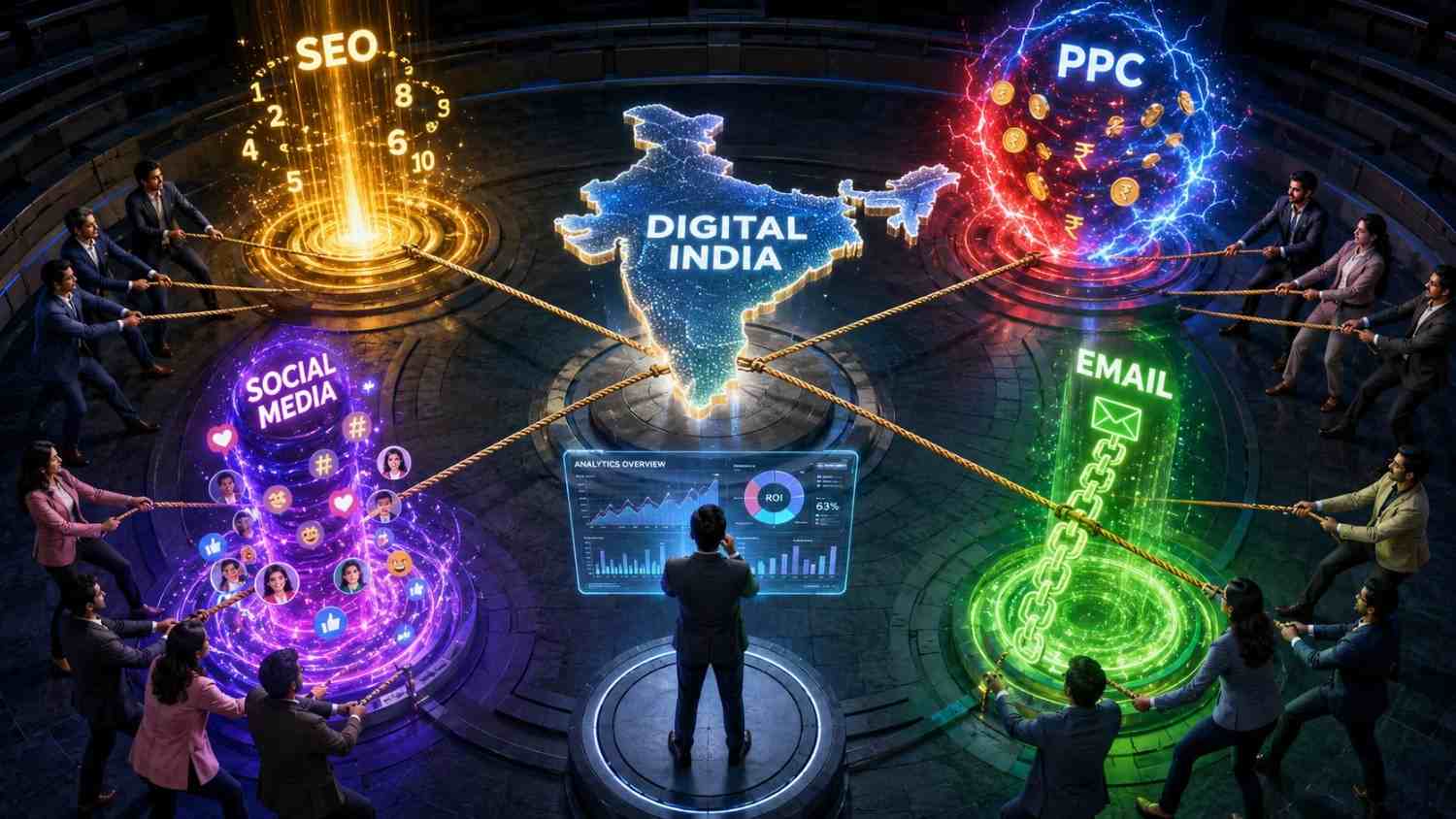
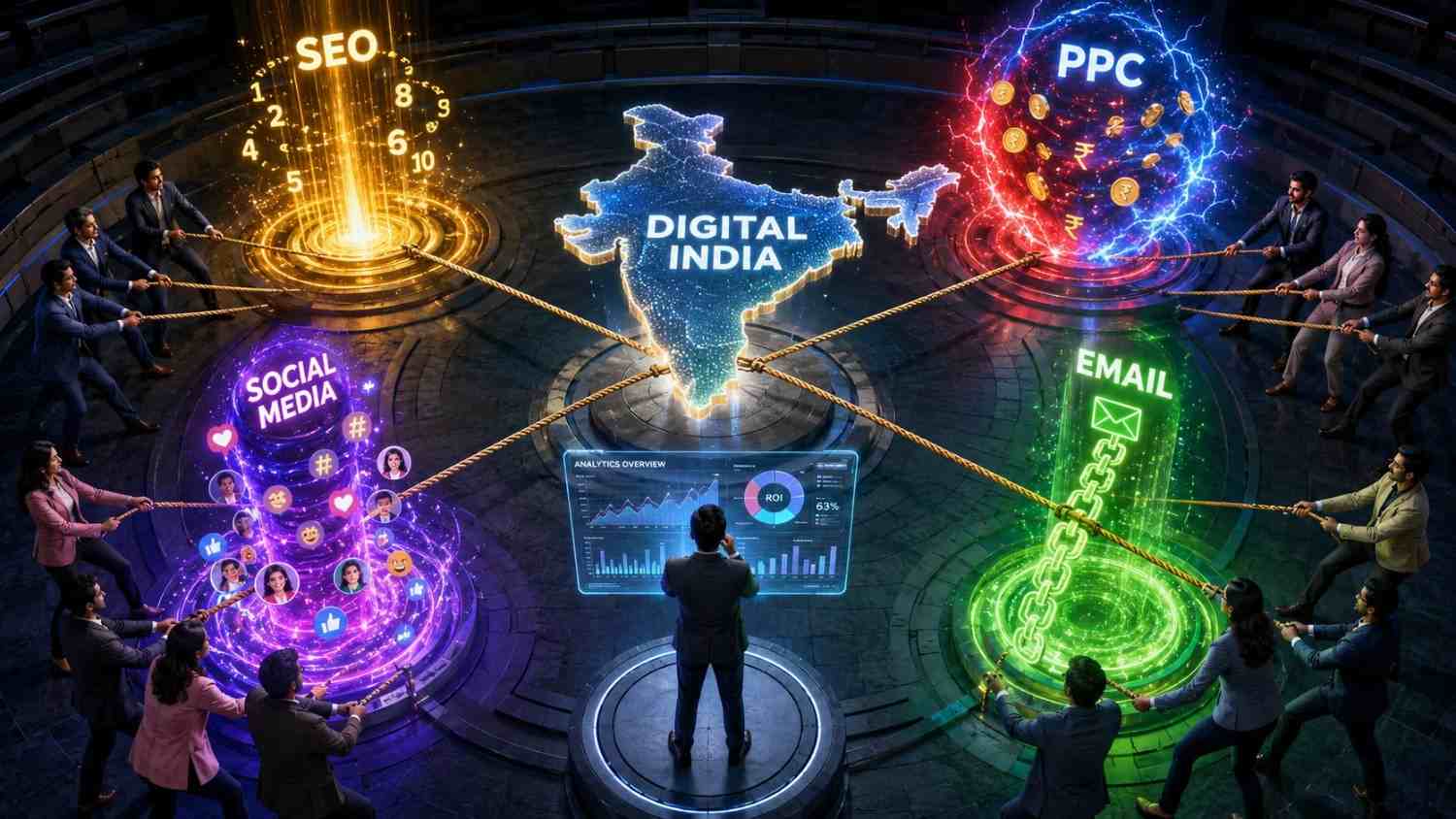
Before comparing anything, it helps to notice something people usually skip past. SEO, PPC, social media and email aren't four versions of the same tool doing the same job in slightly different ways. Each one solves a different problem for a different kind of customer, at a different point in that customer's thinking.
SEO catches someone who already has a need and is actively typing it into Google. PPC buys a spot in front of that same kind of person, except the visibility lasts only as long as the payments do. Social media works on someone who wasn't looking for you at all until a reel or a post put you in front of them anyway. Email, and increasingly WhatsApp, keeps the conversation going with someone who already knows a business exists but hasn't pulled the trigger yet.
Once that separation is clear, arguing over which channel is "better" starts to feel a bit beside the point. A dentist in Coimbatore typing "root canal cost near me" at eleven at night is in a completely different headspace than someone scrolling Instagram on a lazy Sunday evening with chai in hand. Could even be the same person on two different days. Different moment, different channel needed.
Why SEO Rewards Patience
Picture a clinic running Google Ads for six months straight. Every enquiry has a cost attached to it, no exceptions. Then a slow month arrives, the owner pauses the campaign to save some cash, and the phone practically stops ringing within days. That's just how paid advertising behaves. It works only for as long as the tap stays open.
SEO moves the opposite direction, slower and far less dramatic. A blog post published today about, say, "best diet after gallbladder surgery" might sit there quietly for a month or two, barely read by anyone at all. Then it starts climbing. By month six it could be pulling in three or four genuine enquiries a week without another rupee spent on it since. People consistently underestimate this part of organic search. It builds on itself, and work done today keeps paying out long after anyone has stopped thinking about it. But that only happens if you are understanding SEO properly from the start, rather than treating it as a box to check once and forgetting it exists.
There's also a trust factor here that matters more in India than a lot of marketers give it credit for. Indian consumers have grown fairly tired of ads, partly because their feeds are stuffed with low-quality ones. A listing that shows up organically on Google still carries more credibility than a paid one sitting right next to it, and this matters even more for decisions people take seriously: choosing a doctor, a lawyer, a travel agent, a restaurant where one bad food safety review can genuinely hurt the business.
SEO takes real time to build momentum, though. In competitive cities such as Jaipur or Lucknow, where dozens of clinics and restaurants are chasing similar keywords, it can easily take three to six months before rankings shift in any noticeable way. A business that needs customers this week can't rely on SEO alone to save it. Something faster has to run alongside it while that slower work builds up in the background.
What You Do While You Wait: PPC
That gap is exactly where paid search and paid social step in. A Google Search Ad puts a travel agency directly in front of someone typing "tour package from Chennai to Ooty" at the exact moment they search it, no waiting around for rankings to climb. The trade-off is straightforward enough. You pay for every click, and in a handful of categories that cost climbs fast. Legal services and cosmetic procedures, for instance, can run anywhere between fifty and over a hundred and fifty rupees per click in a crowded urban market.
Meta Ads, across Facebook and Instagram, suit visually driven businesses well. A restaurant can put up a plate of biryani straight out of the kitchen. A travel agent can run a short reel of a misty hill station at sunrise and let the visuals do most of the convincing. Organic reach on Facebook has been sinking for years now, worth saying plainly. Posting for free barely reaches a fraction of a page's own followers these days. On Meta, a business is mostly paying to be seen rather than earning that visibility through content alone anymore.
So when does PPC actually earn its cost? A new business with no online history yet, needing quick proof its offer even works. High-ticket services too, surgeries, international travel packages, where a single sale covers weeks of ad spend easily. Seasonal spikes, festive catering orders or summer holiday bookings, where the window to convert is short and there simply isn't time for SEO to mature.
There's a mistake that shows up again and again, though. A clinic sitting in one corner of a city like Bhopal running ads across the whole metro area ends up burning money showing itself to people who will never make the trip. Tighter geographic targeting, usually within five to eight kilometres of the actual location, saves budget and lifts conversion rates noticeably. That single change alone has probably rescued more ad accounts than any clever ad copy ever has.
The Customer Who Was Never Searching in the First Place
Search isn't where every customer starts. A large chunk of people find a business simply by scrolling, seeing something interesting, and thinking, that looks good, let me check it out. That's a fundamentally different starting point from someone typing a query with clear intent, and it calls for a different approach.
Posting daily on Instagram or Facebook doesn't cost anything upfront, but the platform throttles how far it actually travels. A restaurant in a growing city like Surat might see forty or fifty views on a fairly average post, unless something about it happens to catch on more than usual.
Here's something most generic marketing content never mentions. In India, WhatsApp Business quietly outperforms Instagram for a surprising number of local clinics, restaurants and travel agents. Appointment confirmations going out over WhatsApp. A daily menu photo shared to a broadcast list. A tour itinerary sent as a PDF the moment someone enquires. A lot of the real conversion happens right here, and it rarely gets counted as "marketing" because it doesn't look flashy enough to notice.
Social media isn't really a substitute for search. It works better as something that arrives right after search, adding a layer of trust to it. Someone finds a clinic through Google, then opens its Instagram to check whether the place looks clean, whether the doctor seems approachable, whether real patients are leaving comments that sound genuine. Skip that step and a business loses a bit of confidence the customer needs before actually picking up the phone, even when its SEO has done everything right.
What Happens to the Customer Who Isn't Ready Yet
There's another gap most small businesses never plug. Someone finds you through Google or Instagram, likes what they see, but isn't ready to buy right now. Maybe the price feels a little high in the moment. Maybe they want to compare two more options first. Maybe they just get distracted and forget entirely. Without some way of staying in touch, that person quietly disappears, often for good.
Email is technically supposed to handle this, and on paper it has the best return on investment of any channel discussed so far. That only holds true if there's already a list worth emailing, though, and for most small local businesses, building that list properly is genuinely hard. A neighbourhood restaurant or clinic stays close to useless on email until it has a few hundred engaged subscribers, and getting there takes real, deliberate effort at the point of sale or booking.
A travel agent sitting on a database of past customers is in a different position entirely. A well-timed email before the next holiday season, sent to people who already trusted this agent once, can produce a surprisingly strong return, since repeat travellers tend to respond well to a familiar name showing up in their inbox at the right time.
In the Indian market, SMS and WhatsApp broadcasts frequently beat formal email newsletters for local businesses, and it's worth being upfront about that. Open rates on WhatsApp run far higher than email for most consumers under forty. Email still has its place, particularly for bigger, more considered purchases, but it shouldn't be the first channel a small local business bets everything on.
What Actually Changes When You Are Marketing in India
A few realities separate marketing here from the generic playbook found on most global marketing blogs, and ignoring them tends to cost real money.
Most customers in growing Indian cities are browsing on entry-level Android phones over patchy mobile data. A website that takes six seconds to load loses a meaningful chunk of visitors before it has even finished rendering. Every extra second past roughly two seconds raises the odds a fair bit that someone simply gives up and leaves.
There's also an expectation of an instant response the moment someone lands on a page. A Google Business Profile with a visible "Call Now" button and a direct WhatsApp link routinely beats a beautifully designed website that loads slowly and hides the phone number three clicks deep. Sounds almost too simple, but it works because it removes friction at exactly the moment someone is ready to act.
"Near me" searches have grown sharply across smaller Indian cities over the past few years, as people get more comfortable searching in the moment rather than asking around for recommendations first. A lot of why local SEO matters more than chasing national rankings for most small businesses working out of cities like Nagpur, Coimbatore or Indore comes down to exactly this shift.
Language adds one more layer. A large share of searches happen in a mix of English and the local language, phrased in ways a standard keyword tool often completely misses. Something like "Indore ka best doctor" performs differently in Google's results compared to "best doctor in Indore," and a content strategy built purely around clean English keywords leaves a fair amount of search traffic sitting on the table, unclaimed.
So Where Should You Actually Start
None of this needs to be complicated once a business looks honestly at where it actually stands.
A new restaurant with no website has no business spending its first rupee on Instagram ads. Setting up and properly optimising a Google Business Profile, paired with some basic local SEO, matters more early on, simply because people search "restaurant near me" long before they ever open Instagram looking for dinner ideas.
A clinic that needs patients this month can't really afford to wait around for SEO to kick in. A tightly geo-targeted Google Ads campaign, combined with a well-optimised Google Business Profile, addresses that kind of urgent medical intent in a way organic search just isn't fast enough to match.
A travel agent heading into festive season faces a similar timing problem. Bookings tend to happen two to four weeks out at most, so PPC paired with WhatsApp follow-up usually beats a slow-building SEO strategy that won't mature in time for the season anyway.
An established business that already has a working website is sitting on assets worth optimising instead of starting from scratch. Pairing SEO with email, and actually using the customer base already built up, tends to bring the best long-term return here.
A business with something like six months of runway, without urgent cash pressure breathing down its neck, is arguably in the strongest position of all. Starting with SEO first and layering the other channels on top later tends to pay off the most, mostly because everything else gets cheaper and easier once organic search is already carrying part of the load.
Why It's Worth Understanding SEO Properly
Once SEO starts working, the other channels tend to get more efficient too. PPC campaigns often get cheaper because Google rewards a well-optimised, relevant website with a better Quality Score. Social content performs better once more people are actively searching for the brand name after seeing it somewhere else first. Even email lists grow faster, since SEO keeps feeding in fresh visitors who can eventually turn into subscribers.
That connection isn't just a strategic nicety. It comes down to a fairly mechanical process happening in the background every single time someone types something into Google, and understanding how Google actually finds, stores and ranks a page makes almost every decision in this piece easier to act on with confidence. That mechanical process is exactly where the next part of this conversation picks up.
Frequently Answered Questions (FAQs)
1. Which digital marketing channel is best for a small business?
Honestly, there's no single "best" channel , it depends on how customers search for you, where you're located, and how fast you need to see results.
2. Is SEO better than PPC for local businesses?
SEO builds up slowly but keeps working after you stop actively pushing it, while PPC gets you traffic the moment you turn it on and stops the moment you don't. A lot of local businesses end up using both, just at different stages.
3. How long does SEO take to show results?
It's rarely instant, for most websites, you're looking at a few months before the improvements are actually noticeable, depending on how competitive your space is.
4. When should a business use Google Ads?
Google Ads makes sense when you need enquiries now, not in three months, especially if people are already typing in searches for what you sell.
5. Is social media marketing useful for local businesses?
It works well when your business is visual or runs on word-of-mouth, a salon or a restaurant, for instance, builds trust just by showing up regularly in someone's feed.
6. Should small businesses focus on SEO or social media first?
That comes down to how people find you, if they're searching Google for your service, SEO deserves the first push; if they're discovering you through content, social media probably matters more.
7. Is WhatsApp useful for digital marketing in India?
Definitely, a lot of Indian businesses already run enquiries, appointment reminders, offers and even their entire menu through WhatsApp with existing customers.
8. Why is local SEO important for businesses in India?
It's what gets you found when someone nearby searches for what you do, and for a clinic or a local shop, that nearby search often matters more than ranking nationally.
9. Do businesses need email marketing if they already use social media?
Not strictly, but email is one of the few channels that keeps you in touch with people who already know you, useful for repeat customers or anything with a longer decision cycle.
10. How should a business decide which digital marketing channels to use?
Figure out where your customers actually look for information and how quickly they tend to decide, then pick channels that match that, trying to be everywhere usually just spreads you thin.
Comments